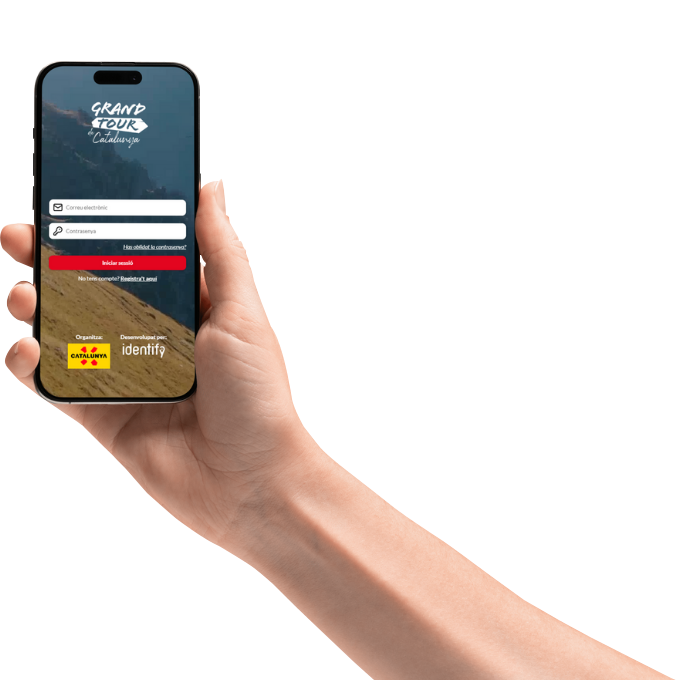
Grand Tour of Catalonia
digital passport
A stamp-collecting game!
Follow the route on your mobile!
Scan the QR code and start collecting stamps at the checkpoints on the Grand Tour of Catalonia.
Hunt for stamps and complete your digital passport of the Grand Tour of Catalonia
If you are looking for culture, nature and gastronomy of Catalonia, the Grand Tour of Catalonia passport is your digital game. Go on a roadtrip of over 2,000 km while hunting for stamps, answering questions about the territory and earning points that will be exchanged for exclusive reward.
How to use the Grand Tour of Catalonia digital passport?
1. Access the digital passport
Register for the Grand Tour of Catalonia digital passport or scan the QR code you will find at the tourist offices.
2. Create your profile
Sign up with an email and password, and validate your user to start hunting for stamps.
3. Turn on your mobile location
This is important. You will need to turn on your phone’s location and be within a radius of less than 300 meters from the point you are visiting to be able to answer the questions and earn stamps.
4. Explore the map
Travel the more than 200 points available in the Grand Tour of Catalonia digital passport, answer the questions we propose, and build your stamp collection.
5. Win rewards
With every must-see spot you visit and every stamp you collect, you’ll earn points that you can redeem for prizes.

Stamps and Essential Points of the Grand Tour of Catalonia digital passport

How to hunt for stamps and win points

Prizes for completing the digital passport of the Grand Tour of Catalonia

Pay attention to the surroundings and discover curiosities

Build your collection of the Grand Tour of Catalonia digital stamps
Play the Grand Tour of Catalonia
A digital passport with 200 checkpoints to stamp the must-see spots along the route in an interactive and collectible journey. Complete the tour and claim your prize!.
Frequently asked questions about the digital passport of the Grand Tour of Catalonia
Everything you need to know about the Digital Passport of the Grand Tour of Catalonia.
How do I register for the digital passport of the Grand Tour of Catalonia?
Access the digital passport from the link or scan the QR code you find at the tourist offices, and create a free profile with your email and a password. Once registered, turn on your mobile location and you can start playing.
What routes does the digital passport of the Grand Tour of Catalonia include?
The journey is divided into five sections of the Grand Tour of Catalonia:
Section 1 (Barcelona – Tarragona): Vineyards with a taste of the sea.
Section 2 (Tarragona – Lleida): Encounter with history.
Section 3 (Lleida – La Seu d’Urgell): Very close to the sky.
Section 4 (La Seu d’Urgell – Figueres): Ode to nature.
Section 5 (Figueres – Barcelona): From surrealism to modernism.
How can I unlock a stamp or an essential point?
To be able to unlock a stamp or an essential point and add it to your passport, you must physically be there. Thanks to your phone’s location, the map will know when you are near the place. Only when you are at an approximate distance of 300 meters will the option to answer the question and add the points be activated.
Do I have to travel the 2,000 km of the Grand Tour all at once?
Not at all. The Grand Tour of Catalonia is designed for you to do at your own pace. You can travel it in sections, organize weekend getaways, or continue the adventure whenever it suits you best. Your digital passport does not expire, so it will always wait for you to resume the journey where you left off.
What happens if I close the mobile browser, will I lose my points?
Don’t worry, your progress is completely safe. All your milestones, the record of the sections completed, and the rewards are saved in your Profile. You just have to log back into the web app with your email and password to resume the adventure where you left off.
Is there any cost to participate and use the digital passport of the Grand Tour of Catalonia?
No, access and registration on the platform are completely free. You only need your mobile phone to create a profile and start playing.
Join the GeoTour and go geocaching!
The route of the Grand Tour of Catalonia now also becomes a great outdoor adventure with a pioneering GeoTour where you can find hidden treasures!
What is the GeoTour of the Grand Tour of Catalonia?
It’s a game where you can look for 50 geocaches hidden near the digital passport stamps! In each section of the route, you will have to find 10 geocaches that will turn the route into an exploration challenge for the whole family!
How to find the geocaches of the Grand Tour?
Very easy! You just have to register, prepare your backpack, and follow the clues to start the search for these physical treasures. You will find the coordinates of the geocaches in your digital passport, but you should know that the exact coordinates of each treasure are secret and you can only reveal them from your profile. Register now and start playing!
- Enter your digital passport
- Discover the stamps that are part of the GeoTour.
- Find the 50 hidden treasures (10 in each section).
- Many of the geocaches can be near or inside the tourist offices.
- Win a collector’s Geocoin.
Discover the official Geocaching website
And remember that if you complete the entire GeoTour, you will win one of the 50 exclusive, numbered, and limited Geocoins of this campaign.
Hurry up, they’re going fast!
Saber +
Si tienes más tiempo,
también puedes
visitar...
The Castle of Cardona crowns the promontory on which this community is based, whose golden years were during the Middle Ages thanks to the salt trade. Although the precious mineral was being mined as early as the Neolithic period, it was the Cardona Population Charter, which sets out the perpetual right to mine salt, which ultimately allowed wealth to flood its streets. The mines again became very important in the early twentieth century, and were still in operation until 1990. Following their closure, a cultural park was set up to protect the former mining operation. Today, you can discover the Castle of Cardona and the Salt Mountain Cultural Park through two guided tours and two theatrical tours: “The true story of the Minyona Tower” and “Alchemy Project”: the secret of the Liber Salis. On the first, we will discover the most important spaces of the old city castle, including the church of Sant Vicent and the legends that have emerged between its walls. On the visit to the mine we are accompanied by two scientist explorers following in the footsteps of a fifteenth-century alchemist. It’s very exciting to follow in the miners’ footsteps and enter the galleries, 86 metres deep. Interestingly, Cardona was the location for some of the main scenes from Orson Welles’ film Chimes at Midnight.
In 1983, archaeologists Joan Santacana and Joan Sanmartí began excavations of the Ciutadella Ibérica de Calafell, a settlement founded in the early sixth century BC. It is thought to have been the fortified settlement of a warlord of the Cossetans tribe, the Iberians who lived in Camp de Tarragona. Between 1992 and 1994, the village was rebuilt using experimental archaeology techniques and an educational museum approach, following the example of the Ekertop site on the Swedish island of Öland. During the visit, we can climb the towers and walls or enter the houses, silos and workshops to see reproductions of everyday objects and find out what a day was like in the life of an Iberian community. The fortress forms part of the Iberian Route, a cultural tourism project promoted and coordinated by the Archeology Museum of Catalonian.
Two world-renowned painters, a musician and an architect were born or spent long periods in the Tarragona regions: Joan Miró, Pablo Picasso, Pau Casals and Antoni Gaudí. Joan Miró went to Mont-roig to cure himself of typhoid fever. The family farmhouse (mas in Catalan) he occupied became his summer refuge for 65 years. In Mas Miró you can see part of the vital anecdote of the painter, who went so far as to affirm that all his work was conceived in Mont-roig. The colours of his works were those of the town: the red of the Mare de Déu de la Roca hermitage, the blue of the sky, the yellow of its flowers and the green of the carob trees. Horta de Sant Joan will always be linked to the name of Pablo Picasso, who also came to the town seeking to recover from an illness. In Horta de Sant Joan, he did not only recover but also turned the landscapes of Terra Alta into the protagonists of his cubist works such as in the paintings La bassa d'Horta or the La Fàbrica d'Horta d'Ebre. "Everything I know I have learned in Horta," said the artist from this town who today dedicates the Centre Picasso to his memory.
El Vendrell is another town linked tightly to a different genius, where it is possible to visit the house where Pau Casals was born in 1876; one of the most important cellists of all time. In the nearby maritime district of Sant Salvador, he build La Vil·la Casals, a house that in his own words was the ‘expression of his life as a Catalan and an artist’. Currently, it is a museum dedicated to his work and person. Reus, the capital of Baix Camp, was also the birthplace of the internationally renowned artist Antoni Gaudí, who spent the first sixteen years of his life in the city. Although he never built in the city where he was born, Reus dedicates an interactive interpretation centre to him, the Gaudí Centre. In this one, among other things, one can learn that the hypostyle hall of Park Güell hides a system for collecting rainwater, or that the famous Cross of Gaudí was inspired by the pinecones of the cypress trees. Reus has also twenty-six modernist buildings, that are works of renowned architects like Lluís Domènech i Montaner or Pere Caselles i Tarrats.
The PortAventura World adventure park has been growing since its inception in 1995. It features six themed areas: Mediterranean, Polynesia, China, Mexico, Far West and SésamoAventura, aimed at the youngest members of the family. Some of the most sought-after attractions are the Shambhala, a large roller coaster that reaches speeds of more than 130 kilometres per hour; Furius Baco, another coaster dedicated to the world of wine; and Angkor, a Cambodian-inspired water adventure that takes you on a boat that goes into the jungle, where different wild animals are ready for a water gun fight. A big naval battle brings the exciting adventure to an end. Another hallmark of the park is the high quality of its shows, whose programming is renewed annually, including performances and themed days around holidays like Halloween and Christmas. The entertainment is complemented by Ferrari Land and the Caribe Aquatic Park. In the Cavallino Rampante area, recommended for the whole family, we can become drivers thanks to an advanced simulator, test our skills as mechanics at a pit stop or feel the power of Formula 1 acceleration reaching 180 kilometres per hour in just five seconds.
Glass manufacturing was a very important activity for this small town until the 1950s. In the museum's upper rooms, they tell us about the history of glass and show pieces for everyday use that were donated by Vimbodí residents themselves. The most interesting part of the museum is the Paco Ramos workshop, where this craftsman demos handblown hot glass, made without moulds. Paco heats, blows, twists, cools and reheats the glass in the furnace, as he goes through the whole process and describes the temperatures he works at to shape these delicate pieces.
Catalonia has several destinations that are part of the Catalan Tourist Board’s Family Tourism Programme. These destinations offer a wide range of services for families, including accommodation, restaurants, activities and experiences designed to be enjoyed together.
The current affiliated destinations are:
- Costa Barcelona: Calella, Castelldefels, Malgrat de Mar, Pineda de Mar, Santa Susanna, Vilanova i la Geltrú, the Baix Llobregat region and the Maresme region.
- Costa Brava: Banyoles, Blanes, Calonge i Sant Antoni, Castelló d’Empúries-Empuriabrava, Castell-Platja d’Aro, L’Escala, Lloret de Mar, Roses, Sant Feliu de Guíxols, Sant Pere Pescador and Torroella de Montgrí-l’Estartit.
- Costa Daurada: Calafell, Cambrils, El Vendrell, Muntanyes de Prades, Salou and Vila-seca and La Pineda Platja.
- Paisatges Barcelona: Cardona.
- Terres de l’Ebre: Benifallet, Els Ports and L’Ametlla de Mar.
- Pirineus: Vall de Boí, Vall de Camprodon, Valls d’Àneu, Pirineus-Noguera Pallaresa, the Berguedà region and the Pallars Sobirà region.